
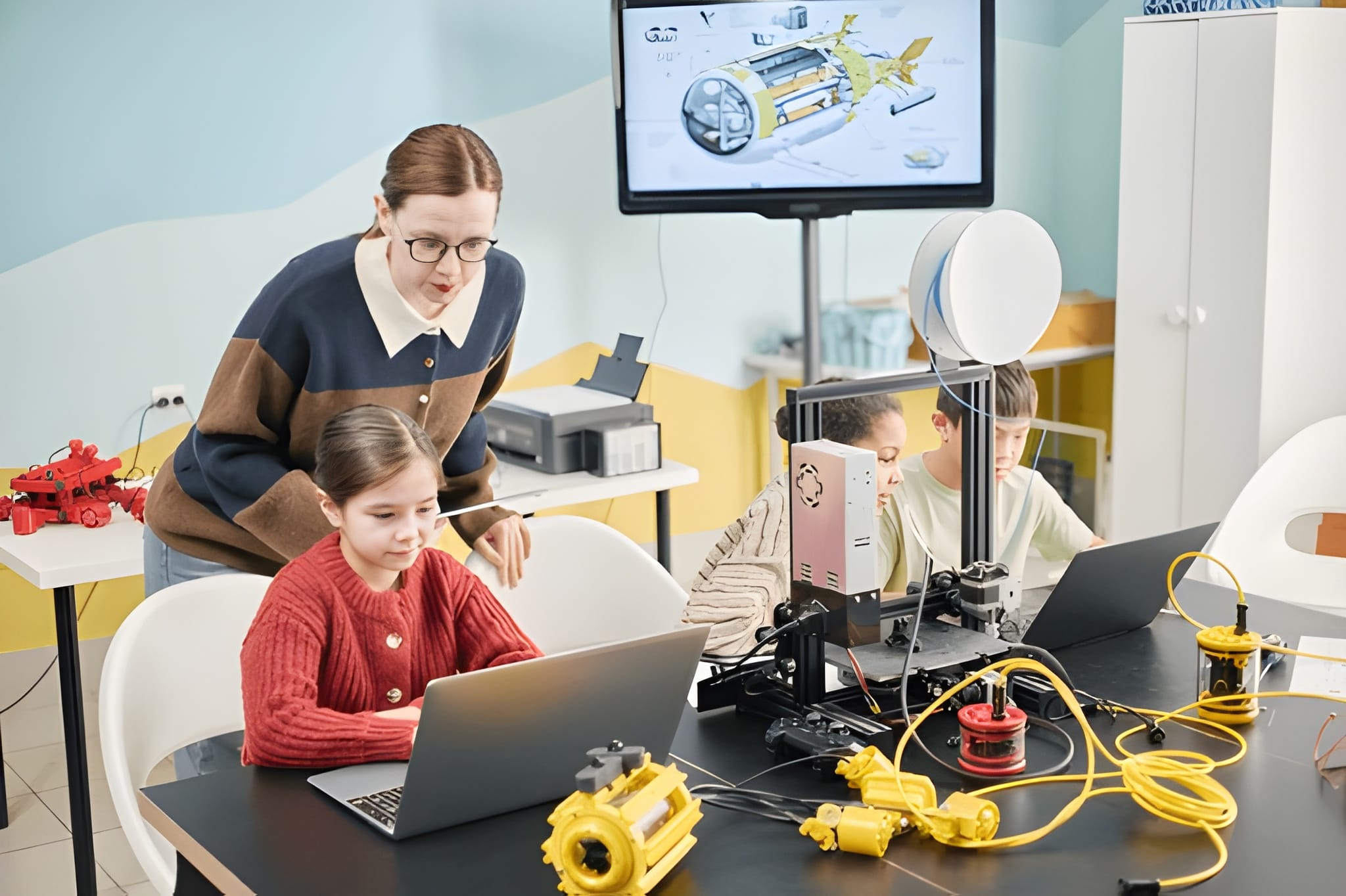
Today, young individuals find themselves growing up in a fast-paced digital world, constantly surrounded by screens and supported by structured activities that leave little to no space for exploration and creativity. However, creativity is not something that can be learned solely through instruction – it thrives when children are given the opportunity to experiment, imagine, and engage with the world through a “real” body, not just the mind. That is where hands-on learning steps in and plays a crucial transformative function. Hands-on learning allows children to touch, build, experiment, and explore via first-hand means, sparking the curiosity and creative thinking skills needed to innovate and approach problem-solving. Whether children are engaged in art, science, building, or nature exploration, children have what it takes to find or think differently, make discoveries, and develop lifelong learning passions. Therefore, the paper begins with a brief discussion of hands-on learning and its important role.

Understanding Hands-On Learning and Its Importance
Creative tendencies seldom thrive in a situation when one is nervous about his or her mistakes. Hands-on learning ensures that a child learns through trial and error and attaches mistakes to a learning process rather than a negative outcome. When manipulating materials, testing out their ideas, and seeing the outcomes, a child can begin to think like an innovator. For example, if a toddler assembles the tower from cubes that crutches, he or she learns about equilibrium, structure, and tenacity. Thinking critically provides a solution to trying different methods, but there is room for originality. Unlike the traditional way of memorizing facts, experimenting fosters the use of both sides of the brain, which is a holistic form of learning.
The individual learns to solve problems outside the established restricted box, which eventually breeds into unimaginable success. Hands-on learning is akin to exploration experimentation creates curiosity. Literary curiosity is the infancy stage of creativity, and they usually stem from exploring. Too often, children are asked to be silent and not mess with life instruments, depriving them of the ability to be innovative. Children asking, “What happens if…” or “What if it were different” show that they are being curious. Unfortunately, some are rarely given the leeway to explore happening for themselves.
Attaching Learning to the Real World
Another strength of hands-on learning is that it attaches classroom learning to the real world, making it more meaningful and memorable. For example, pupils learning geometry might make shapes out of sticks and clay, or a project on sustainability could include planting a small garden. When kids work with real materials, they see how what they’re studying is relevant to the world around them. This not only creates their deeper meaning and understanding, but it also encourages creative thinking. By experiment with their ideas in situ, children begin to regard the world as a source of possibilities for exploration and innovation. Since learning becomes relevant to their lived experiences, kids become more acclimatized in finding creative solutions to the challenges in their day-to-day lives.

Imagination Increases with Open-Ended Play
Open-ended play, a critical characteristic of hands-on study, is one of the most effective means of constructing the kids’ imagination. Painting, designing, crafting, or acting allow children to narrate their narratives and investigations. Open-ended playing, unlike a structured sport, provides your children unlimited possibilities. A heap of blocks might be a castle, a missile, or a zoo, depend on the creative thinking ability. It demands kids to think abstractly and experiment from the ordinary when they engage in this sort of playing. Engage children’s senses and thoughts open-ended playing boosts creativity by stimulating brain activity. Children can express their minds freely, resulting in both creativity and boldness.
Parents and Teachers’ Role in Supporting Hands-On Learning
In addition to creating opportunities for children to experiment, adults have a role in encouraging such activities. They can create an environment that promotes experimentation without necessarily costing a lot – sometimes materials from around the house can be enough. For example, kids can turn cardboard boxes into a fort, sing with paper cups, or learn about science while on a nature walk. They can also ask open-ended questions such as, “What do you think will happen if we try this?” or “Do you know another way?” Adults should also give children the space and time to innovate without too much instruction. They also should act as facilitators and not instructors – this encourages children to be innovative and original.
Combining Hands-On Learning with Technology
Hands-on learning may involve using tradit8itional materials, but it is also effective for incorporating technology. For example, coding toys for children allow users to create games and learn coding simultaneously. Kids can also design a project on a computer that will involve both aesthetic creation and logic. It is worthwhile for parents and educators to integrate these two environments to teach that both can be used to create and innovate.

Building Confidence Through Creative Discovery:
when children learn hands-on, they feel empowered by the knowledge. They know that they are the ones who discovered something new; who did something remarkable. And every new success story only adds to their mindset. They are no longer afraid to undertake a new project, to share an idea with friends or teachers; there are open to new knowledge. This aspect is crucial for personal development, as such kids are more likely to seek creative solutions, to pursue their passions. In that sense, hands-on learning changes their lives. Parents and teachers must celebrate efforts and creativity rather than the results, as it would help kids enjoy the studying process.
The Long-Term Benefits of Hands-On Learning: one must admit that hands-on learning just like any other type of activity has its advantages. Using hands to study develops a significant amount of problem-solving, critical thinking, communicative and collaborative skills. Kids that have hands-on learning during their childhood are more efficient. They approach the problem with the necessary amount of curiosity and confidence, rather than despair or complacency. Therefore, they are destined to become better innovators, good leaders, and eternal learners. This group of people is the most valuable in the 21st century, as the world values creative and flexible people.
You May Also Enjoy:
Cozy Bedding Kids’ Essentials For a Better Night’s Sleep
Helping Kids Overcome Fear of Exams
Benefits of Roleplay and Drama in Early Education
Making Creativity a Part of Every Day Learning
Fun Ways To Make Kids’ Homework Time Easier
Conclusion:
How to Cultivate a Creative Learning Culture Above all, hands-on learning is not just a way of teaching our children; it is a way of enabling them to experience the world. It is not just thought-provoking but rather a means of inspiring you to actively learn and form tactile, inquiry, imagination, and development. By enabling kids to learn by engaging, we can better develop their thinking skills. Simultaneously, they will feel more confident, more curious, and more problem-solving. Parents and educators alike can encourage their children to take an approach by providing ready-to-use equipment.
By developing a culture of exploration and celebrating when things do not go as planned, kids can realize that it is not about perfection but about trying. When children use their hands and minds side by side, they can learn in a more logical and creative manner. It paves the way for them to become more creative, more self-assured, and more likely to see themselves as innovators and dreamers than ever before. This is how vulnerable adults can assist others in improving the world around them. We may help by offering them a way to see the future rather than merely envisioning it.