
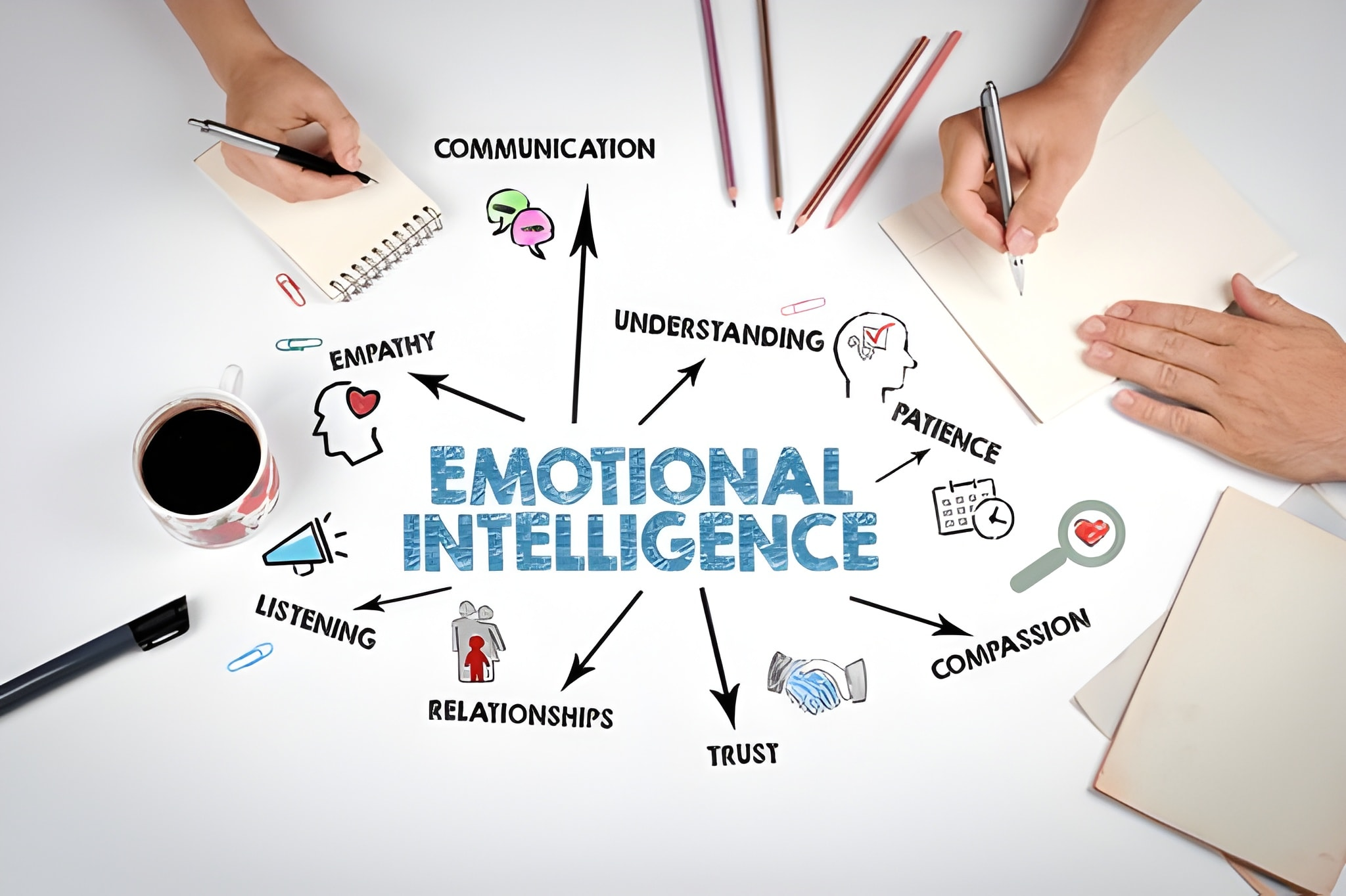
In today’s fast-paced and fiercely competitive world, academic achievement alone is insufficient to guarantee lifelong success. Despite the emphasis placed on intellectual skills such as reading, writing, and arithmetic in traditional education, growing research indicates that emotional intelligence is the most relevant form of intelligence. Emotional intelligence for children is just as essential as mastering academic subjects. Emotional intelligence has a direct influence on how children relate to others, face challenges, and handle stress. It lays the groundwork for personal well-being and academic success. In this post, I will cover the necessity of emotional intelligence for children and how it influences their development. Furthermore, I will provide suggestions for parents and kids to develop emotional intelligence.

Understanding Emotional Intelligence :
Emotional intelligence refers to the capacity to comprehend and regulate one’s own and others’ feelings. According to psychologists Daniel Goleman and Peter Salovey, emotional intelligence is composed of five primary aspects: self-awareness, self-regulation, motivation, empathy, and social skills. It is the ability to know what you are feeling, why you are feeling it, how to control your feelings appropriately, and utilize your awareness to establish solid relationships. These abilities enable children to get through school life, from managing disappointments to cooperating with classmates. Integrated into education, emotional intelligence teaches children not simply how to accomplish well academically but also how to operate in real-world situations with resilience, compassion, and confidence.
Why Emotional Intelligence Matters More Than Ever :
In the digital era, where children are exposed to social media, high performance at schoolwork, and fast-paced living environments. Emotional intelligence can help a child manage anxiety, cope with change, and confront conflict constructively. In addition, emotional intelligence is one of the greatest predictors of success in the long term. It is documented that youths who exhibit advanced social and emotional abilities are more probable to succeed in several aspects of life, including high school performance, healthy friendships, sound mental health, and protection from bulldozing. Simultaneously, children who have difficulties comprehending and expressing their sentiments find it hard to control their aggravation; thus, they frequently are stressed, unengaged, and have a low self-esteem. Thus, parents and instructors who focus on EI are supplying their pupils with materials that will last a lifetime and help them in their relations.
The Connection Between Emotional Intelligence and Academic Achievement
It is a prevalent myth that supporting emotions detracts time from the classroom; in reality, emotional ability improves learning. Children who can control their feelings can concentrate for a long time on a single task and maintain motivation and persistence in the face of failures. For example, a child with good emotional management will not be willing to give up on a complicated math issue; they will continue to try and be patient to get it figured out.. Emotional understanding additionally improves the school environment.
In empathizing with others, students are more inclined to collaborate and accommodate others, resulting in much less time spent out of class and more time spent in it. Teachers agree that incorporating emotional management into their daily lives is a good approach to approach the subject since they all have opinions about their students’ enhanced performance, attendance, and morale; this is due to the vital role emotional skills play in academic success.

Self-Awareness Building in Children
Self-awareness is an essential component of emotional intelligence. It involves identifying one’s emotions and understanding one’s strengths and weak points. For a child, these qualities manifest themselves in how well they can predict their actions based on feelings. For example, in the classroom, a self-aware child can recognize they are getting frustrate or anxious and can take steps to calm down before reacting. Teachers can help develop this quality in kids in the form of reflection, keeping journals, and applying “one-word check-ins” for emotions.
Parents can help by showing youngsters that it is alright to admit their feelings: “it appears that you are sad because playtime is over – it is all right”. With time, a child becomes one with one’s emotions, and outbursts or masking of feelings become rarer. The child becomes more emotionally stable, and through this, they can make better decisions, in their everyday school life and with friends.
Building Social Skills with Emotional Intelligence
Social skills are how children demonstrate their emotional intelligence. They gain children to convey their feelings to interact with others, collaborate with others, and resolve disagreements constructively. At school, attractive social skills allow kids to make companions, work on group assignments, and verbally share their knowledge. Teachers can leverage this behavior through group activities, peer teaching programs, and other co-operative learning activities that value courtesy and explicit communication. Furthermore, parents can likewise foster this at home by speaking respectfully, taking turns speaking, and listening actively during family summits. When children can demonstrate their emotions sincerely and respectfully, they get the results socially. They can be fruitful at promoting a kind, cooperative, and productive classroom culture.
Mental Health of Emotional Intelligence
Emotional intelligence factors heavily in children’s mental health. When children can manage and prevent stress, anxiety, and despair, they are more likely to have a strong mental state. Children who benefit from an environment that profits these abilities have fewer problems conducting, submit their friendliness, and generally feel better about their lives. Emotionally astute children are more comfortable seeking advice from a counselor if they are feeling morose or anxious. This enlists more moderate issues before they become significant mental health concerns. Hence, increasing emotional knowledge prepares children that it is considerable to feel annoyed, melancholy, or anxious, and what is more life-and-death is how they function on those emotions. Parents or guardians and teachers who mean soul-searching around this lifetime set children up for a more robust follower experience.
Integration of Emotional Intelligence into Education
Teaching emotional intelligence isn’t a goal but a methodology to help kids grow into stable, well-adjusted adults. For schools to integrate EI, this means moving away from the sole focus on academic learning to an encompassing approach. Today, many schools offer programs for Social and Emotional Learning that include EI principles as part of the school curriculum. These programs typically teach kids how to recognize emotions, how to set personal goals, how to show compassion, how to develop social connections, and how to make responsible decisions. In the classroom, there are some exciting activities like “emotion journaling,” mindfulness exercises, and exciting group reflections to reinforce these concepts. At home, parents can continue learning by providing empathy, showing gratitude, and keeping lines of communication open. When teachers and parents work together to embrace emotional intelligence, kids become more responsive in every aspect: emotionally, socially, academically, and psychologically.

The Lifetime Benefits of Emotional Intelligence
The effects of EI don’t stop when childhood ends or is even confine to one generation. Early EI children grow up to be more accountable, compassionate leaders, better communicators, and kinder friends. They exhibit healthier, satisfying relationships, more robust career connections, and robust mental health. Emotional intelligence enhances adaptability, which is severely needed in a world where change is constant. By practicing identifying and expressing emotions, children grow up to be individuals capable of handling challenges with soundness, empathy, and faith. Virtually instructing emotional intelligence is a sophisticated wager on a child’s lifelong well-being and accomplishment.
Final Ideas: Heart and Mind Both Need to be Fed
Education is more than final grades or even test scores; it is about developing emotionally literate, well-rounded people. When children know how to recognize their unique feelings, handle anxiety, relate with insight to others, and converse efficiently, they are fully equipped to thrive meaningfully, healthy livelihoods. Together, parents and educators can make a meaningful impact; when we include social studies in our daily work, whether this is talking to your child’s siblings softly when we feel nervous or healthy acknowledging when a student is trying. By cultivating the heart as well as the mind, we encourage children to succeed in school, life, and work at every level.